- Book info
- Sample
- Media
- Author updates
- Lists
Synopsis
The charming conclusion to the Sunken Archive duology, a heart-warming magical academia fantasy filled with underwater cities, romance of manners and found family, perfect for fans of Emily Wilde's Encyclopaedia of Faeries.
Former correspondents E. and Henerey, accustomed to loving each other from afar, did not anticipate continuing their courtship in an enigmatic underwater city. When their journey through the Structure in E.'s garden strands them in a peculiar society preoccupied with the pleasures and perils of knowledge, E. and Henerey come to accept—and, more surprisingly still, embrace—the fact that they may never return home.
A year and a half later, Sophy and Vyerin finally discover one of the elusive Entries that will help them seek their siblings. As the group's efforts bring them closer to E. and Henerey, an ancient, cosmic threat also draws near...
“An underwater treasure-chest to be slowly unpacked, full of things I adore.” —Freya Marske
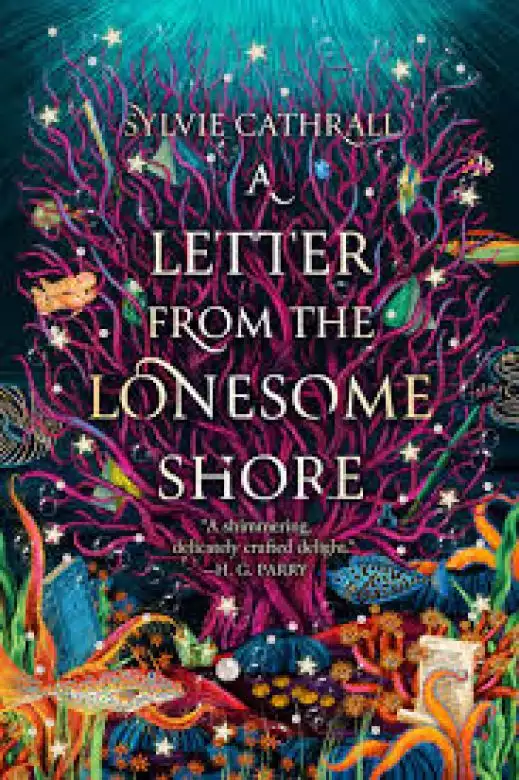
“A shimmering, delicately crafted delight.” —H.G. Parry
“A fascinating and charming story told in a uniquely elegant voice.” —Louisa Morgan
“Both the setting and the story are exquisite.” —Megan Bannen
Release date: May 6, 2025
Publisher: Orbit
Print pages: 400
* BingeBooks earns revenue from qualifying purchases as an Amazon Associate as well as from other retail partners.
Reader buzz
 Please log in to recommend or discuss...
Author updates
A Letter from the Lonesome Shore
Sylvie Cathrall
To any Scholars of the future who may read this,
Today, I’m afraid I discovered that I am the sort of person who reacts to unprecedented adventure in the same way your average Frangible Jellyfish responds to the most incremental change in water temperature. That is to say – by nearly perishing with all due haste.
What an awfully bleak way of beginning these notes! I brought only my scientific journal with me, and I hate to sully it with anxious ramblings of a personal nature. If I thought I might encounter a purveyor of fine stationery in the fathomless depths, I would toss the whole book overboard and start afresh. I daren’t even cross out the preceding sentences, because it is so very quiet aboard our vessel, and, as I tend to scribble with great vigour, E. will certainly hear me, and I don’t wish to trouble her more than I already—
Shall we leave those gloomy lines as they are, then, and begin once more?
I believe it has now been a short while since my dear E. and I reunited at her majestic Deep House and set off on our expedition. I say “I believe” because the hands of my pocket-watch still spin about with jaunty irregularity, and, besides, I do not feel confident in my ability to track the hours accurately at present. Because I am, I’m sorry to say, a bit of a mess – an emotional shipwreck – a weak-limbed limpet!
Perhaps I am also too self-critical. I described myself using those very words (weak-limbed limpet, etc.) just a moment ago, and E. immediately offered a firm rebuttal. I agree; such phrases are neither kind nor fair! Yet I cannot help but think back to the previous iterations of Henerey Clel – the young boy, paging through books of Fantasies and dreaming of extraordinary experiences – the young man, doing much the same – and feel the weight of my past selves’ shame as they realise I have commenced the most noteworthy venture of my life (and of our generation?) in such a pitiable fashion.
You see, E. and I did not quite intend to find ourselves lost in some inscrutable sea. For my part, I came to the Deep House today for the primary purpose of visiting the correspondent who has lately grown so dear to me. My spirits soared as we navigated my borrowed depth-craft to that vexing Structure in the coral reef that comprises E.’s garden. I’m afraid my own giddiness rather prevented me from fully considering all potential outcomes of our little sojourn.
Naturally, the most unlikely outcome was precisely what awaited us.
Moments after we docked onto the Structure – just as I was considering whether I could risk glancing fondly at her again – we were suddenly plunged into absolute darkness. Though the interior lights in the depth-craft activated quickly, all I could see outside was impenetrable murk. No luminous fish, no shadowy deep-sea whales, not even a solitary bubble. I had imagined such scenes before, when I yearned to take part in the Ridge expedition, but I had never experienced the all-encompassing depths myself. As my eyes adjusted, the depth-craft continued to shrink around me. I became convinced I was pressed into a glass slide in some sublime scientist’s microscope. I could feel only the confining motion of those hungry, heavy seas – well, that and an intense rocking sensation that would not cease.
“What is the cause of that infernal shaking?” I asked at last, surprising myself with my ferocity. Never have I sounded so much like my brother! I tried pulling my eyes from the portholes to anchor myself to E.’s face. Under the grim silver lights, she looked resolute and metallic, like some sculpture of an esteemed Scholar from centuries past.
“I fear you are the one shaking, not the depth-craft.” Her frown alarmed me. “What is the matter?”
I responded by promptly losing my ability to breathe. My head spun. I gasped like a beached Forbearing Shark. I tried desperately to focus, but I could not stop panting and heaving. Shapes and colours swam about me.
I remember hearing the ghost of E.’s voice politely asking if she could help me sit. I nodded a vague assent. I felt the faintest touch of her hands on my shoulders (which, in retrospect, I regret that I barely had the ability to appreciate at the time) as I collapsed into the navigator’s chair.
“You will be all right, Henerey,” said E., seemingly from afar.
“Do you – what is – am—” I sputtered (or some fragments of that nature – I cannot recall the exact phrasing).
“I promise you shall survive this. I believe you are suffering from an attack of the nerves, and they only linger for a few moments. For a count of one hundred, let’s say.” Her voice bobbed like a buoy, and I tried to let my mind swim for it.
“May I count it for you?” she continued. “And would you kindly hold on to this for me as I do?”
I heard a click and felt a cold chain of shells and pearls drop into my palm. A distant part of my brain remembered that E. was wearing a necklace with a nautilus design on the pendant. I ran my fingers along the carved nautilus, the pointed spires of the shells, and the smooth curves of the pearl beads, and let the current of my terror carry me as far as it could.
To my surprise, I began to return to myself as E.’s gentle voice counted to twenty, then fifty, then eighty. The pressure on my chest somehow vanished. After she reached a hundred, I felt exhausted, but otherwise recovered. Still, I could hardly look at my companion. I also had no desire to see that horrible void of the ocean again, so I focused on the floor of the depth-craft (which desperately needed sweeping).
“I am terribly sorry,” I said. “I don’t quite understand what just happened. How did we reach these depths so swiftly?”
“I believe we’ve travelled.”
At last, I found myself sensible enough to detect the perfectly understandable tremor in E.’s tone. I couldn’t help but infuse my next statements with reassuring cheer.
“Well, that certainly explains why we no longer appear to be in your garden. So the Structure does indeed possess powers of transportation, as we hypothesised. But does that explain what came over me just now? Was it some kind of protective – I don’t know, curse, or something of the sort, created by the Entry? Like in The Vengeance of the Thermocline?”
To my surprise, E. unfolded the supplementary navigator’s chair from its hidden panel in the ceiling and sat right by my side. When I dared to look at her, I observed such genuine sympathy in her eyes. It was the visual representation, I would say, of the kindness expressed so openly in her every letter.
“I have experienced many such attacks in my life,” she said. “All occurred under quite ordinary circumstances. I am not surprised in the least that one could be triggered by what we just experienced.”
“But I felt like I was dying!” I coughed politely to distract from the unpleasant way in which my voice cracked at the end of this exclamation. “Could a mere attack of the nerves truly affect me so?”
“I fear many use the phrase ‘attack of the nerves’ to refer to any moment of anxiety. In actuality, it describes a particular physiological experience that I would not wish upon anyone – especially not you.”
Previously, I would indeed glibly say that I had experienced such an attack as an overdramatic way of describing a burst of intense worry – such as what occurs when one goes to examine a tank full of Good-Humoured Shrimp, only to find that one’s research assistant accidentally placed a Ravenous Grouper amidst the innocent crustaceans! I did not, however, confess this to E., as I was far too preoccupied with the stimulating challenge of relearning how to catch my breath.
How much worse would I have felt were E. not with me? I could not bear to think of her experiencing anything similar, either. Had she truly survived “many” of these attacks? Who – if anyone – spoke gently to her and helped her through that terror when she did? (If only it could have been me!)
“It would appear,” I said, pleased to hear my voice growing stronger, “that Chancellor Rawsel was wise to exclude me from the Ridge expedition. I suspect I may have a most unforeseen aversion to deep water. But how are you faring, E.? Did you not say in one of your letters that depth-crafts make you claustrophobic? If so, you are certainly managing it admirably.”
“Fortunately, this is the most spacious depth-craft I’ve had the pleasure of boarding,” E. replied. “And – well, it’s rather curious. I found that my desire to help you through your distress temporarily eclipsed any anxieties I might have experienced myself.”
“I am happy to be of service.” (And I did truly mean that!)
“To be clear, I am now appropriately alarmed,” she continued. “To calm myself, I am doing my best to think of my sister and her colleagues down at the Ridge, and how they live and work and joke and care for each other in such an environment without a second thought. Because we can’t see anything out there, I’d like to imagine that we will float past Sophy and Niea in their diving suits at any moment.”
In response, I tapped the navigation system, hoping the depth-craft would reveal something of the landscape outside (or, perhaps, E.’s dauntless sister come to rescue us). Instead, a sharp warning chime indicated that the lamentably outdated equipment could not recognise any topography.
“My dear E.,” I said, slowly, “would you agree that we have, perhaps, found ourselves in rather more adventurous circumstances than we anticipated?”
She nodded. “I don’t know what I thought would happen after we, well, entered the Entry. Henerey, I can barely brave a single day outside my home, and now I’m adrift with you in an unknown ocean. Whatever was I thinking? I can’t apologise enough for forcing you into such a nightmare.”
“A nightmare? Isn’t that going a bit too far? Now that the attack of the nerves is behind me, I’m having a marvellous time.” I attempted the most comforting smile I could muster – which, in truth, is not particularly difficult when gazing at her. “Besides, do recall that this is not the first mysterious journey you’ve survived. Why, you’re the more seasoned adventurer of the two of us!”
“Isn’t that going a bit too far?” Her focus shifted from me (alas) to the ocean outside. “But I do find our present situation most peculiar. We are, evidently, still underwater. I assumed that if the Structure were to carry us anywhere, it would have to be… there.”
Her dramatic emphasis on the last word was unnecessary, as I knew exactly where E. imagined we would end up. “There” was an island on a luminous and lonesome sea, where E. had travelled – by some art or technology unknown to us – and she’d told none but me of her journey.
“We may yet be nearby.” I gestured towards the portholes without looking at them. “During your previous adventure, you were only returned to the Deep House after you spent some time ashore. Perhaps we need only pass a few pleasant hours on that island to be sent home.”
Ever the optimist, I took the opportunity to give the automatic navigation panel one more go. With the system continuing to resist, my initial technique for locating the island simply involved steering at random as we sat in companionable silence.
After a short spell, E. offered to relieve me from my duties at the helm. I think she fears I am still weak from the attack, and she is not incorrect! That is how I have come to enjoy this brief respite and write about my experiences. I cannot guess what might happen next, but I hope we will soon find what we seek. If the mysterious creators of the Structure were skilled enough to construct a device that could carry people across vast distances, why did they not design it to deposit said passengers in the correct location?
As I write, I’ve thrice now heard E. inhale as if to speak, but no words followed. I wonder if I should encourage her. Would that be appropriate? We have only enjoyed a short time in each other’s physical presence, and I am not sure what rules of conversational behaviour apply to our interactions. Yet we always communicated most comfortably in our letters. (We even spoke of love, though I certainly lack the courage to broach that topic face to face!)
Surely I should not say anything. Surely it would sound patronising – and perhaps unsettling – if I were to cut in, but—
“E.,” I said in a near-whisper after several moments (approximately accounted) passed, “what are you thinking?”
She glanced away from the helm to meet my gaze. How sharply green her eyes are – like the scales of a Permissive Wrasse when the surface light catches them – but that is not quite the point, is it?
“I am beginning to worry, just a little, about being away from the Deep House.”
How wonderful that I can already recognise her unsubtle use of understatement!
“We’ll be back in no time, I’m sure,” I said, “and, depending on the hour and your willingness, I might have no choice but to stay for dinner.”
“We won’t enjoy much of a meal, I’m afraid, if everything flooded because I neglected to properly check the systems before we departed.”
“Do you mean the systems regulated by that funny panel near the airlock door? If so, perhaps it will reassure you to know that I distinctly remember seeing you push a great many buttons there.”
Then E. smiled, truly, and I remembered how remarkable it is that we are here, not as correspondents, but simply as two people existing in the same place – enigmatic though that place may be. For a moment, I felt dizzy again. It was not another attack of nerves, but rather a beautifully swirling light-headedness that seemed more electrifying than alarming.
“That does reassure me,” she said. “Still, I predict it won’t be long until I am overcome by a state of panic that renders me most unbecoming.”
“Impossible!” I exclaimed before I realised what I was saying.
“I assure you that it is not merely possible, but also highly likely.”
“That is not exactly what I meant,” I muttered, wishing one could cross out embarrassing statements in life as in letters. O, but luck is on my side at last! Before she could ask any clarifying questions about what exactly I found impossible, the enormous head of some unknown beast (a Refined Oarfish? No, they could never brave such depths!) slammed into the frontmost porthole of our depth-craft. The ocean possesses such perfect timing!
Dear “Thirtieth Second”, or whatever your true name happens to be,
I thought I would open this letter by declaring my victory. Instead, it seems we have reached a rather frustrating impasse. While that is most perturbing, and will set back my progress significantly, I must congratulate you nonetheless.
When I agreed to take tea in your study, it was only for the purpose of stealing that box of documents you keep so naively in plain view atop your crystal cabinet (or, at least, that rectangular structure described as a “cabinet” in my world). That was why I suddenly asked you to check if a bird had struck the window – for I had set a wind-up automaton of mine to flap against the glass at that precise moment. My intricate creation lured you away, leaving me to my machinations. To guarantee my success, I forced myself to wear an uncharacteristically elegant cape with what should be an illegal number of ruffles, all of which were perfect for secreting what I sought to obtain from you. After we said our farewells and that funny machine (should I call it a “Structure”, an “Entry”, or a “Sculpted Saviour”? They are all the same thing, aren’t they? Whyever are those three distinct terms used interchangeably? I do wish someone would standardise the nomenclature post-haste) transported me home, I felt almost disappointed that you proved such an easy target.
Thank you – and curse you too, of course – for proving me wrong.
For I have now deduced that when you stepped to my right, offering what I assume is the equivalent of a plate of fruit pastries in your civilisation – which I happily accepted, smug as I was with your secret archive newly in my possession – you chose that precise moment to slip your dainty hand across the brim of my hat, which sat stately and proud on the back of my chair, and procure the following objects: a microscopic shorthand copy of the log from the Perspicacity, a needle-sized scroll of blueprints and research notes, and a memory-recorder from a most singular Automated Post machine. Have I made any errors in my suppositions? No need to answer – I know I have not. I rarely make errors, which is why I am astonished by how wrong I was to assume you are merely an innocent from the bottom of the sea. Or wherever your city actually is. My employer once attempted to explain the broader cosmology to me, but I have no interest in the nature of the universe or anything beyond my immediate perception. The work I do involves only what I can see, touch, and take.
That is all to say that I do not know much about you, Scholar “Thirtieth”, nor, for that matter, the world you inhabit. At present, my task is simple – acquire, for said employer, all documents relating to a particular incident of historic import and the Cidnosin family’s involvement therein.
Do I care about the Cidnosin family’s involvement in anything, historic or otherwise? Not personally, I suppose. By sheer coincidence, I did happen to know something of them before this commission. In my previous career as a Courier, I operated a mail-boat, and I remember becoming particularly frustrated by the unreasonable number of letters E. Cidnosin began receiving on a near-daily basis during the year 1002. Then Automated Post took off like the tide, and the Deep House was destroyed, and Courier work became sparse. To keep myself in spending money and ships, I decided to try my luck in the controversial field that many Boundless Campus Scholars describe in hushed whispers as “Document Acquisition”. (Are such questionable activities present on the other Campuses, I wonder, or is the drive to succeed by any means necessary specific to my own home? Don’t bother answering. I am well aware that you wouldn’t understand a thing about our Campuses.) It was not the first time I considered such a profession. In fact, as a little girl, I—
Look at me, rambling on about unrelated personal matters as if I were one of those Cidnosins myself! Let me simply say that from the moment I adopted my striking Acquisition Alias (which is critical, if you wish to be taken seriously) and began rifling through other people’s possessions with glee, I knew I had hit upon my calling. After all, I spent years modelling discretion while delivering letters – I cannot deny the secret pleasure I take in being able to read them at last! Because of the rather precarious (and not undeserved) reputation of my new profession, the number of Scholars who will deign to utilise my services is somewhat limited. But I do get by, so here we are.
To return to my original point – let us now consider the unique situation in which we find ourselves. At present, each of us holds precisely the documents that the other needs. Under the circumstances, may I propose a begrudging business arrangement?
I will return the documents I stole from you (after I make copies of them) if you promise to do the same. I would not want either of us to renege before every paper returns to its rightful place. The pages I’ve included for you, extracted from the diary of one Scholar Henerey Clel, are both proof of threat and of good faith.
I hope you will not keep me waiting. Perhaps you, too, serve an employer who yearns to have your files back in their possession. I await your correspondence eagerly.
As sincerely as I can manage,
L.
Dear “L.”,
Hello there! Would you believe that this is the very first time I ever replied to a letter from a stranger? Until recently, I was not acquainted with anyone besides my Scholarly colleagues – and we exclusively communicate with each other in person (or through rather testy comments in our daily records). As a result, I was delighted to see your note appear on the fascinating “Automated Post” device that my new friend Scholar Sophy Cidnorghe left behind for me, but it took me some time to formulate a response.
You see, I fear you misunderstood the entire situation. At the same time, I find your misunderstandings fascinating!
I have no “employer” in the way you suggest. What an old-fashioned concept. Imagine being compensated for information! No, I work in service of a greater cultural imperative, which necessitates excellent record-keeping in every aspect of our lives. It is for this reason I am most disappointed that you would steal the documents created by certain members of the Cidnosin and Clel families during their time with us. Before formally adding those papers to our archives, I needed to set them in new waterproof bindings, convert dates from our own calendrical system to correspond with your world’s, and attach any relevant addenda (such as assorted drafts from my own records that I blush to read now), which is why the files were temporarily unprotected in my quarters in the first place.
At any rate, when we met, I invited you to tea because I thought you seemed like a friendly person (and because it is still rare that a stranger like you visits our city). When I noticed your attempts to deceive me (there are no “birds” here, incidentally), my heart sank. I should have confronted you in the moment, but I am not adept at navigating such altercations. Instead, I did what seemed right at the time – I took something of yours. It was my hope that you would notice what you’d lost, realise the hurt you caused me, and return my things with appropriate contrition!
(Considering that you specialise in stealing information, I do wonder why you kept your own valuable documents hidden behind a most obvious flap on your hat?)
I wish to have my documents returned. That much is true. Still, though it goes against my nature – which is generally quite optimistic to a fault – I’m sad to say, my dear “friend”, that I do not especially trust you.
Consequently, would you be so kind as to send me something of mine to start us off?
Otherwise, I shall simply set myself to the onerous but perfectly manageable task of recreating all my missing documents – Henerey Clel’s journal entries, E. Cidnosin’s unsent notes to her sister, even that fateful, final letter written during the very climax of these proceedings – from recollection alone. I do have an excellent memory. If possible, I would prefer not to waste it on a task like this. I simply have too many other things to do!
Dutifully yours,
The Thirtieth Second Scholar (or 30.ii, as we might write it shorthand here)
Dear “30.ii” (what manner of name is that?),
How clever of you to pretend this is all coincidence, and to write in such a sweetly ingenuous way! (“This is the very first time I ever replied to a letter from a stranger”? Spare me, please. Who would believe that anyone other than a literal newborn has never received such a letter before? Correspondence is the centrepoint of society!)
I assume you exaggerate the strength of your own memory. Yet there is something about you – and your correspondence – that intrigues me. (How frustrating.) It’s been a slow few tides in the world of document acquisition, and I find myself in need of entertainment. While I have not entirely bought into your bluff, let us go ahead and pretend otherwise. After all, I’ve heard stranger things about your city and your Scholarly colleagues from my new friend, Niea Cidnorghe. I shall acquiesce to your demands because it would be simply impossible for me to remember the contents of the documents that you lifted so elegantly from me. Even if I could, my employer is a stickler for originals.
Give me a few tides (or however you measure time in your world – I understand there’s some kind of bizarre temporal discrepancy) to make my copies of the Cidnosin Papers, and I shall send them back with the expectation that you will return the favour immediately.
With haste,
L.
Dear L. (however do your colleagues know how to classify you when your name is but a single letter?),
It is no bluff to say that I am immensely patient!
As you make your copies of what you have dramatically termed the Cidnosin Papers, I do hope you enjoy reading them.
I also hope you will not judge me too harshly when you do.
30.ii
DRAFT RECORD BY THE THIRTIETH SECOND SCHOLAR, 1002
By my Oaths as a Scholar, I pledge to record every observation from today’s expedition and swear I will document all I experienced.
Normally, I write “nothing” in my daily records because I have seen nothing, and it would be inaccurate to say anything else. Yet today is different. A successful crossing occurred at last!
I am tempted to mention that I, the Thirtieth Second Scholar, have long dreamed of becoming the first among us to shepherd Imperilled people to safety. Because I am dedicated to concision and precision (and because I know the watchful eyes of the Fifteenth First Scholar will review what I write), however, I shall resist the urge to discuss my dreams and accomplishments at length!
As I do every day, I took the Mechanical Beast Ieneros to patrol the infinite seas that border our refuge. I stood within the very head of my dear Beast, gazing through the window of its vast right eye as is my custom. After several hours of watching the waters (which my Oaths require me to say, truthfully, proved as onerous as ever), my vigilance was rewarded.
For I spotted a small craft, designed in a much less intricate fashion than a Mechanical Beast – its shape nothing more than a simple sphere!
I wonder now if recording my emotional response to this sight would be irrelevant, or whether I must note it for correctness’ sake. I shall err on the side of caution and omit it to reduce the number of hours I must spend listening to the Fifteenth First Scholar’s criticisms. (Of course, I say “criticisms” most respectfully, for I know there is no greater gift a First Scholar can give a Second Scholar than critique… and there is no greater giver of such gifts than the Fifteenth First Scholar.)
I attempted to direct Ieneros to the craft, but I fear the grace of my movements was somewhat reduced. In fact, without even trying, I managed to bring the Beast so close that its head crashed against the porthole of the other vessel!
Assuming that Imperilled people might not be familiar with Mechanical Beasts, I opened one of the speaking-tubes that project like tusks from Ieneros’ mouth and announced myself as protocol demands.
“Be not afraid, wanderers. I am the Thirtieth Second Scholar, and I shall bear you to safety. Do you possess a speaking-tube of your own?”
Though neither the eye of Ieneros nor the vessel’s porthole were completely transparent, I could see through both windows well enough to notice the urgency with which the strangers placed their hands over their ears.
“Apologies,” I whispered through the tube after they recovered from my initial cacophony. “Is this volume more suitable?”
I should note that I will refer to the Scholars by their proper names from this point forth – since I am writing this record after completing my mission, and I think that will lend the most accuracy to the narrative.
At that point, then, the person whom I would come to call Scholar Clel nodded to confirm that my message had been received. The other, whom I now know as Scholar Cidnosin, was warier.
“Be not afraid,” I said again, after determining that such a phrase seemed appropriate to repeat while rescuing those escaping the perils of our forsaken former home.
As little else could be communicated at this juncture, I managed to draw Ieneros back and attach its frontmost claw to their vessel – though I am obligated to record that it took me more than seven tries accomplish this feat. Thus, with the strangers’ craft propelled in front of me by Ieneros’ might, I continued my usual route back home.
I must also note that I noticed, as we departed, what looked very much like the flash of a tail fin in the depths ahead. Because I have no definitive proof that the Illogical Ones were present, I hope I may record this observation without risking any contamination of our records with their magical nonsense.
While Ieneros made its unhurried journey, I continued to watch the pair of strangers through their porthole. I wondered at the nature of their relationship – or, rather, I considered such a triviality only after pondering how they managed to escape their world when all others have failed.
Given their unusual manner of dress, I could not determine their precise fields of study based upon appearances alone. I did notice that they both seemed ill at ease, which is perfectly understandable. I do not know how long they spent drifting through the sea before I found them.
They had one major interaction of note. I record it here only because of my Oaths. Scholar Clel, whom at the time I titled “The Elegant One” due to his excellent posture and confident bearing, seemed troubled by a trinket that he clutched within a tight fist. Occasionally, he would open his hand slightly, glance at the object, and then hide it away before turning back to smile reassuringly at Scholar Cidnosin.
I presume I may spare myself from logging
We hope you are enjoying the book so far. To continue reading...