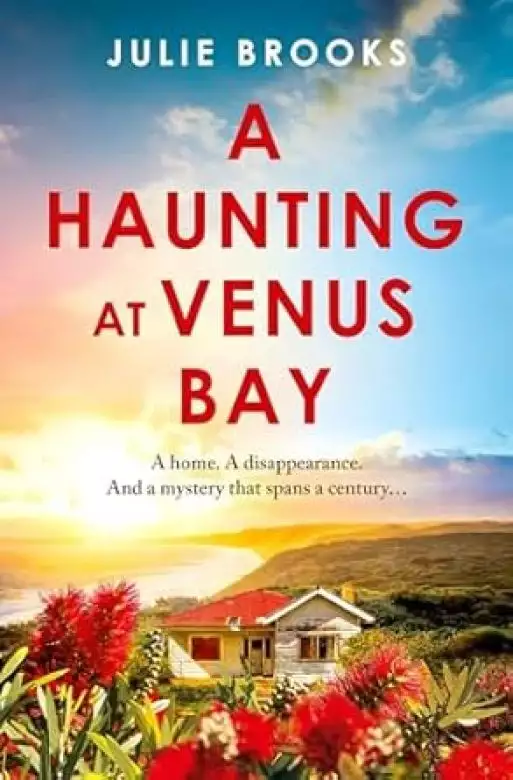
A home. A disappearance. And a mystery that spans a century...
When Cass leaves London with a fractured heart, she plans to settle in Australia, specifically in the beautiful area of Victoria coastline where she spent so many happy holidays. Yet when she arrives, her house is not quite what she'd envisaged - doing a place up is one challenge, living with things that go bump in the night is quite another.
Years earlier, Minna and her mother have escaped war torn Europe to join the fairgrounds. There, Minna meets Albert, a man clearly who wants a wife who will also be a full-time worker on the farm near Venus Bay. Albert has no interest in Minna, nor tolerance of her desire to become a writer. When he, and then Minna, both disappear, the mystery of what has happened to them stays buried, seemingly for ever...
It will take Cass, and the discovery of a hidden book, to unravel the secrets of a childhood and a marriage, and a story that will also help her live again.
Two women, decades apart, and a house that brings them together.
What readers love about Julie Brooks:
'Such a wonderful story. Set across two timelines, two hundred years apart - I loved the way things wove together beautifully' (The Heirloom) #11088; ⭐ ⭐ ⭐ ⭐
'Beautifully written...A story which kept me hooked, with mysteries to uncover' (The Keepsake) #11088; ⭐ ⭐ ⭐ ⭐
'A truly delightful story with fastidious attention to detail...the plot twists and redirects expectations in what makes a thrilling read' (The Secrets of Bridgewater Bay) #11088; ⭐ ⭐ ⭐ ⭐
Release date:
January 8, 2026
Publisher:
Headline
Print pages:
304
* BingeBooks earns revenue from qualifying purchases as an Amazon Associate as well as from other retail partners.
Twenty-five years ago, I first travelled this road, the only access to a small settlement on a narrow peninsular in southern Victoria. The road traversed a plain dotted with grazing cattle and kangaroos, the shallow inlet a smudge of blue in the distance. To the other side, scrub-covered dunes fringed the ocean shore, with tea tree and coast wattle forming an impenetrable thicket. I was all arms and legs in cut-off jeans and yellow bikini then, pedalling a rickety bike belonging to the holiday cottage my parents had rented for the Australian summer. The sun seared my bare shoulders and my freckles multiplied by the day, but the heat, the flies, the scorching sand, the brown flakes peeling from our noses to reveal our northern origins . . . none of it bothered me or my brother, Liam. For we ran wild that summer, while our parents dawdled through their mutual misery.
But now it was late autumn and the south-westerly was bitter. Despite the wind, I caught the faint sound of surf pounding the ocean shore beyond the tea tree, as I stood hugging my arms to my chest beside the road. It must have rained earlier for the damp seeped through my mesh trainers and a snag of wet creeper coiled around one leg of my jeans. The cattle were still here, sheltering in the lee of a sandhill, but the kangaroos were nowhere to be seen, and beyond the open fields the waters of the inlet were a steely grey. And me . . . well, I hid my grey beneath blonde highlights and my wounds beneath a lick of pink lipstick. I suppose I should have known that returning wouldn’t be the same. I wasn’t the same. But the world had seemed full of so much possibility that long-ago summer, that it felt like a good place to start again. In any case, I was here now and it was a long way home, both literally and figuratively, so I zipped up my parka, tucked in my chin and squinted into the wind.
I was returning to the ageing Volvo that Liam had insisted I borrow, when a series of high-pitched whistles issued from the scrub. The unfamiliar call ended with a whiplike crack that seemed to echo in my ears long after the bird, or whatever it was, fell silent. I shivered a little, at both the sound emanating from the dunes and the cold infiltrating my parka, then opened the car door and climbed in. The house should be just up ahead.
I pulled out on to the road, heading for Venus Bay’s second estate. There were three estates on this narrow finger of land, each separated from its neighbours by stretches of low-lying pasture or wetland that were threatened with inundation when the oceans rose. Once, before the arrival of holiday cottages and retirement bungalows, it had all been farmland or scrub, and before that the land of the Bunurong people. Their middens dotted the miles of dunes along the coast. Past the third estate, the road ended. Nothing but scrub and sea beyond.
Driving through the first estate earlier, I had noticed only two or three other cars and one lone pedestrian – a rain-jacketed man walking a golden Labrador – who glanced up briefly as I passed, then reached down to give his dog a pat, as if to say, ‘Don’t mind her.’ The deserted streets seemed to match my mood. When I set out from London a week earlier, I had expected to feel, if not excited when I arrived, at least hopeful. Yet all I could feel was a hollowness in my stomach at the enormity of what I had done, leaving London, my career, my friends, parents – my tribe – behind. ‘Trashing my life,’ as one of my less supportive friends put it.
A few moments later, and the car’s navigation system assured me that I had reached my destination. But there was no sign of the old timber cottage with dark green windows from the real estate website. I cruised past a modest, well-kept house with aluminium windows and a neat gravel drive, then a misshapen cypress tree that loomed over the road with a gloomy air, followed by a wall of tea tree. Where were the lopsided front veranda and the red-brick chimney? Where was the stately eucalyptus standing in an expanse of emerald lawn? Where was the house that I had bought, sight unseen, in a fit of existential panic?
I slowed the car and made a careful turn, circling back the way I had come, driving more slowly this time. Houses didn’t disappear overnight. On my second pass, I noticed a narrow gap between the spreading cypress branches and the thicket of tea tree. A gap, where a crumbling drive of mottled concrete could just be made out. Beside the drive, with gaps in its broken green baseboards and paint flaking from its timber windows, I caught a glimpse of the house – my house. Even through the insect-splattered windscreen I could make out patches of rust on the corrugated iron roof and the detritus of sticks and leaves filling the gutters. But the tree was there, standing in its field of calf-high grass, its branches reaching towards a sun hidden behind a blanket of cloud. I breathed out in a sigh of relief.
Of course, my brother had advised against buying the house. Called it a ‘money pit’ in his best Tom Hanks impression. I preferred not to heed his warnings for I had already made up my mind. Drawn up my escape plan. My survival strategy, so to speak. I only agreed to him inspecting the house on my behalf to make him happy. To relieve him of responsibility for his younger sister’s decisions. Liam had been looking out for me since we were kids, but I was forty years old now. Well and truly capable of taking care of myself, I had reassured him, recent events notwithstanding. If I wanted to decamp to the other side of the world with my kitbag of woes and make a new life for myself, that was my decision. Some would say I was running away. I preferred to think of it as a refurbishment – and refurbishing was my business, after all.
So, trying not to second-guess my decision, or fixate on the house’s utilitarian ugliness and obvious faults, I scraped past the mangled cypress and overgrown tea tree, parked the car on a patch of concrete towards the rear of the house and switched off the ignition. I was determined to focus on the affordable price. After all, in my work as an interior designer, I had turned many a client’s ugly duckling house into a swoon-worthy Instagram swan. There was no reason why I couldn’t achieve a similar result for a humble timber cottage in an out-of-the-way village at the bottom of the world. And once I had completed that transformation, well, then I could . . . well, I could decide then.
I opened the door and placed one damp trainer on the concrete, the other still parked on the car’s rubber mat, when a blur of something small and pink landed with a plop on the bonnet of the car, surprising me so that I hit my head on the door jamb. A baby bird. Clearly, far too small to be out of its nest. I looked up, scouring the tree for its parents, to discover two ravens perched on a branch high above me. They were slightly smaller than a British raven but just as dour, regarding me with a piercing glare. One of the pair sidled closer to its mate, puffed out its throat feathers and gave a raucous wail, remonstrating with me for daring to intrude on their territory. The cottage had stood empty for years, after all. They didn’t appear interested in the chick though – clearly not their offspring.
‘Yes, eff off to you too,’ I muttered, rubbing my head as I climbed out of the car.
‘Here, let’s have a look at you,’ I crooned, leaning over the bonnet to inspect the almost bald chick. It was so tiny and helpless. So vulnerable. It couldn’t be more than a few days old. Too frail, too young, to survive alone.
There was something about the hatchling that constricted my chest so that I struggled to take a breath. Perhaps I should call the local wildlife rescue service, or make a temporary nest for it, hoping its parents were watching. Liam and I had once made a nest out of a Wall’s ice-cream tub for a baby blackbird we found in our garden in London. That had turned out quite well in the end. But this hatchling’s eyes were closed as it lay unmoving on the Volvo’s blue bonnet.
One of the ravens wailed again and I looked up to find the two perched shoulder to shoulder like twin gargoyles, watching me.
‘There’s no way you’re getting this little guy.’ I glared at them in warning. Then I reached out to scoop up the chick and cradle it in both hands, my fingers gently touching its fragile body. It was so light that I would barely have registered its weight if it wasn’t still warm in my hands. I felt no beating heart beneath the almost translucent skin. The fall, or the ravens, had killed it.
I buried the chick in a patch of earth and animal droppings beneath the cypress tree, where no grass grew, scraping at the earth with a stick. Then I fumbled for the house key in an envelope at the bottom of my handbag and marched the last few steps to the front door.
What can I say about those first moments after I entered my new home? What can I say about the scent of musty floral carpet and long-closed doors? Of roller blinds so past their use-by date they tore at a single touch? The entrance hall was narrower than it had appeared in the photos, the rot in the corner of the front window frame more extensive than even Liam had suggested. But the two front bedrooms were a decent size. The furniture that had come as an obligatory purchase with the house was mid-century ugly rather than modern, although at first glance there were a couple of pieces I might keep. The house was freezing. Colder than the grey autumn day outside, as if a chill wind had blasted through every room, leaving only cold and clammy breath in its wake. No living body had spent a night here in years to warm the frigid air. At least, nothing human. I didn’t like to dwell on any rodent occupants.
I followed through the short hall to a combined living/kitchen/dining area. Thankfully, the kitchen must have been updated sometime in the 1980s, judging by the vinyl floor covering, the white laminate cupboards, the white wall tiles with their floral embellishments and the aged electric range with its coiled hotplates. The red-brick fireplace appeared to have been colonised by spiders, and although the living-room windows were smaller than I would have liked, they did overlook the garden. One entire wall was taken up with bookshelves from floor to ceiling, some sagging under the weight of old paperbacks and hardbacks with faded jackets. The books buttressed the room, weighing it down – or holding it up, I couldn’t be sure.
I picked a book at random from a row of hardbacks, the illustrations on their spines suggesting they were probably published in the 1960s or 70s. The cover was a bold cyan, with a line drawing of two children, a girl and a boy, kneeling in the sand, the suggestion of a creature lurking in the windswept grasses of the salt marsh. ‘The Lost Seal by M. T. Adams,’ I read aloud, sighing at the thought of stacking all these books into boxes and finding them homes. I did hate tossing out books. It felt as if I was throwing away a part of someone’s life. And although I did my best to oblige, I could never truly understand those clients who required a ready-made library from their interior designer. Didn’t they want to choose their books for themselves?
With The Lost Seal re-shelved, I stood for a few moments, looking out over the overgrown grass and scrub of my own little patch of earth, and imagined what I might make of it all. The house couldn’t have been more different to the elegant London flat where I had spent the last six years. Yet I had set out on this journey purposefully to remake my life; the cottage was as good a place as any to begin. I could work with what I found here, and in the meantime, at least the kitchen appeared relatively hygienic, if an affront to good taste.
Thirty minutes later, having hauled my luggage from the car and deposited the suitcases in the front bedroom and the carton of cleaning supplies in the kitchen, I sank down on to the bare wire bed base and sighed in relief. The linked coils supporting the wire mesh creaked in protest, and I decided that my first and immediate purchase must be a decent bed. The foam camping mattress I had borrowed from Liam was a very short-term solution.
And on cue – as if he was reading my thoughts – the phone buzzed in my back pocket and I pulled it out to find his name, number and unflattering profile photo grinning back at me. (Liam could be counted on to pull a face whenever you tried to take his picture.) He was brown haired and green eyed, like me, with an oval face and high, freckled cheekbones. But where his nose was nicely slim, and straight, mine had a bump and was more aptly described as ‘Roman’.
‘Hey, Cass.’
‘Hey, Liam.’
‘What’s happening?’ he said, far too bright and chirpy to be believed. My brother was rarely chirpy. It was clearly a disguise for his true feelings. ‘Ah . . . are you there yet?’
‘Do I detect an “I told you so” in your voice?’
‘No. Just wondering how the drive down went.’ A more gullible sister might have believed him, but I let it go. He was always on my side, even when our arguments were at their most familial.
‘Good. Thanks for lending me the car. I’ve just unloaded and am taking a breather before I start on some cleaning.’
‘How’s the house, up close?’ He was biting his tongue; I knew it. Liam was never needlessly dour or pessimistic, he was more of your pragmatist. As an accountant, facts and figures were his daily bread. Solutions were his gravy. Especially tax.
‘Let’s just say, I love the trees.’
‘Hmm. Big job, sis.’
Several seconds of silence followed and I suspected he was thinking of the many late-night calls where I had unloaded about Philip and my life in general. But I was up for the challenge. I knew I was.
‘Our mother called,’ he said. ‘You know she’s thinking of returning to Australia?’
‘I suppose that makes sense now that I’m here too. George and Maddie would love it.’ Liam’s kids adored their grandmother and she adored them. Their British grandfather, our father – though he loved them to bits – was unlikely to follow. Dad’s second wife, Jenny, a lovely woman, wasn’t quite that accommodating.
‘I told her to wait until you’re settled.’
‘Meaning, wait and see if I change my mind and run back to London?’
‘Something like that.’
‘Well, thanks for the vote of confidence.’
‘I have confidence in your talent, your capability, your work ethic, Cass. But I wonder whether, once you’ve renovated the cottage, you might decide to return home.’ His voice had that patient tone I’d noticed he used when one of his children was being especially intransigent. He was silent for a few seconds, the only sound a printer churning pages in the background, and then he said quietly, ‘You can’t go back, Cass. We’re not the same people now.’
Apparently, he had been thinking about that long-ago summer too. I wasn’t going back, though, I was moving forwards. I just wasn’t sure towards what yet.
‘We’ll just have to see, then, won’t we?’ I said.
‘Well, I’m here if you need me.’
‘Thanks, Liam, you big softie.’ I leaned back with a sigh, not wanting to think about all that might or might not lie ahead. It was too much for a single day.
‘Ow! What the . . .’ I cried, springing upright to stare in dismay at a pearl of red welling on my palm.
‘What?’
‘I think my bed just bit me.’
Later that night, still struggling with jet lag, and exhausted after hours of scrubbing, I retreated to the bedroom where I spread the camping mattress gingerly on the hostile bed. Outside, the garden was a wall of darkness. The house creaked in the wind, whether the scraping of an errant branch or the protest of a poorly secured vent pipe, I couldn’t tell. I sniffed the stale air, making a mental note to wash the curtains in the old concrete laundry tub first thing in the morning, then I decided to unpack a few clothes.
I stowed my underwear and T-shirts in a tall chest of drawers. Despite its dovetailed joints, the piece was ugly, and would have to go, though the old picture frame hanging above the tallboy was more interesting. Strangely, someone had turned it to face the wall. A child bored after too many house inspections perhaps. The elaborately carved dark wood, the oval shape and dangling iron chain were intriguing even from the back. I reached up with both hands and turned it around, careful not to scrape the delicately carved oak leaves against the wall, only to find my own face looking back at me. Slightly foxed, and wavering a little in the imperfect antique glass. Not a picture frame but a mirror. German, from the Black Forest, mid- to late nineteenth century, at a guess. I’d bought something similar for a client’s Victorian terrace three or four years ago. Well, the mirror could definitely stay.
Next task was to hang up a few clothes to recuperate after their journey. I pulled a camel wool Max Mara skirt from my suitcase – not that I would be wearing anything other than jeans, leggings and track pants for the next few weeks (months). The wardrobe was a handsome burl wood with Bakelite fittings but the veneer was chipped and peeling in several places, and one of the handles was missing. I pulled at the remaining handle and, when it resisted, turned the brass key in the lock.
I opened the door to see a stack of four drawers and a hanging rod bare of coat hangers. The only item hooked over the rail was a bamboo cane, and fastened to that cane was a doll about six inches high. A kind of old-fashioned kewpie doll. Not the naked cherub with a fat tummy of Japanese mayonnaise fame but a glitter-fairy kewpie with a sparkling purple cap of hair, her face and arms emerging from a swirl of dusty tulle. The kind of doll sold at fairgrounds. She might have been cute once, despite the layer of dust, but where her eyes should have been, she gazed out of two ragged holes.
Someone had poked her eyes out.
And despite my months of careful planning, despite the little pills that helped me get through those early days and my flight of ten thousand miles, a flood of unwanted memories rushed over me and shame curdled like sour milk in my gut.
The doll stared back at me as if she knew all my secrets.
‘You’re just a doll. What can you know?’ I said aloud, hoping the sound of my own voice would ground me in the here and now. The doll might not truly know, but I knew. For how could I forget that day at the doctor’s clinic in South Kensington? Probably the day when my world finally fell apart, if I’m honest. Even more so than the night Philip walked out of our apartment and set that fall in motion. I didn’t want to remember but the doll seemed to give me no choice.
I suppose I could have entertained myself on my phone, while waiting that day in London, but the phone held too many traps for an idle mind. Being prey to my own thoughts in a place where I had once waited with such unalloyed hope made me nervous. There’s nothing remotely charming about a gynaecologist’s waiting room, and my doctor’s rooms were no exception. Rows of serviceable chairs, a coffee table with a selection of magazines, calming images of ocean, forest and flowers on the walls. Just like any other private medical centre’s waiting room.
I picked up one of the magazines fanned out on the glass coffee table and began to leaf through it. As a designer, I appreciate interiors magazines, but on this particular day, in this particular place, the choice turned out to be a poor one. There was nothing unsettling about the initial pages, just the usual quasi editorial PR about hot new furniture designers and artisans skilled in the timeless craft of Japanese paper making or some such. It wasn’t until I flicked through to the feature articles that my world crumbled around me.
‘At home with jewellery designer Ava Green in a remote cottage on the North Yorkshire coast.’
I read the title, feeling an itch of presentiment before I even got as far as the first subheading. For so it went. An old story. A clichéd story – couldn’t I at least have been felled by something more original? There was Ava of said remote cottage . . . curled up on her moss-green love seat reading the latest literary prize-winner. There she was, sketching jewellery designs at an antique Swedish scrubbed table, staring wistfully through the window at a rugged seascape beyond, and musing in an 18-point pull quote, ‘You can sense all the past lives that have been lived here.’
And there he was, on the next page, Ava’s surgeon partner . . . sitting on a beach with one arm draped around her shoulders as she warmed her hands at a fire, while a shaggy dog of no discernible breed flopped on the shingle beside him. The man I had spent eight years loving, the man I still loved, and whose baby I had once hoped to have. There he was, enjoying the dream country cottage I had longed to share with him, living the cosy, domesticated life that in the end he had said he didn’t want. Or, as it turned out, he didn’t want with me.
My fault, perhaps I should have anticipated the clichéd story of the new, younger lover. I had known that she existed, this woman with the pretty smile and silky brown hair. But I hadn’t known that she had become a fixture in his life – or that she had won his heart in a single year, when I hadn’t managed to claim it in eight.
And to my shame, I hated her for it.
I hated myself for it.
Jealousy is so boring, isn’t it?
There were several pens in my bag, but I remember that the one my hand found first was a black uni-ball. I scribbled out one eye in Ava’s grinning face and then the other, before the pen took on a life of its own, defacing her long silky hair, her Barbour jacket, her Hunter wellingtons, as if I could erase her from his life. And mine.
Now, six months later, I could still taste the bitterness of that moment – grapefruit with a side order of shame. It had been so childish. So pointless. So inescapable. But this was now my new life and I had renounced the old. I didn’t need a celluloid doll, fast losing her glitter, glaring at me from a cupboard and reminding me of the past.
I unhooked the doll from the hanging rail and surveyed the room for somewhere to stow her out of sight. The obvious place was under the bed but the foam camping mattress only covered part of the wire base, leaving anything underneath half exposed. I wanted her right out of my sight before the flood of memories returned to further unsettle my hard-won equilibrium and destroy my sleep. The window beckoned and darkness hid many a sin. It was a struggle to open the old timber frame one-handed. It had seen too many coats of paint. I stuffed the doll under my arm and shoved upwards, the sash cords squealing in protest. When I felt the rush of cold air flood in, I took the doll in one hand and hurled her like a spear into the night. Tomorrow, I would hunt her down and deposit her in a bin.
Summer
1953
The clowns were laughing at her, Minna decided. Heads tossed back, red mouths gaping, all lined up in a row, laughing at her. It didn’t matter that they turned first one way and then the other, backwards and forwards, casting their gaze impartially over the Korumburra showgrounds. She knew they were laughing at her. For why wouldn’t they? All the fun of the fair and she was stuck standing there, hour after hour, her day measured not by minutes but by the occasional fairgoer pausing to buy one of her novelties. With a quick glance to check whether anyone was watching, she waited for the moment when the clowns were facing her again and stuck out her tongue. There, that would show them.
Further along sideshow alley, Olive Mullins was on the line-up board outside the Mullins’ tent, enthusiastically spruiking the family’s latest show.
‘Plenty of excitement here, ladies and gentlemen. And plenty of room inside. Don’t be shy. It’s a continuous show. We have the Lovely Lena; her beautiful young body tattooed all over. I defy you to find a square inch of space not covered by tattoos. Come on in, ladies. Come on in, gents. No need to wait. Not only is the Lovely Lena here for your edification, but we have Violetta, the lady snake charmer with her giant pythons . . .’
Not much excitement at the novelty stand, Minna thought. She si. . .
We hope you are enjoying the book so far. To continue reading...

 Please log in to recommend or discuss...
