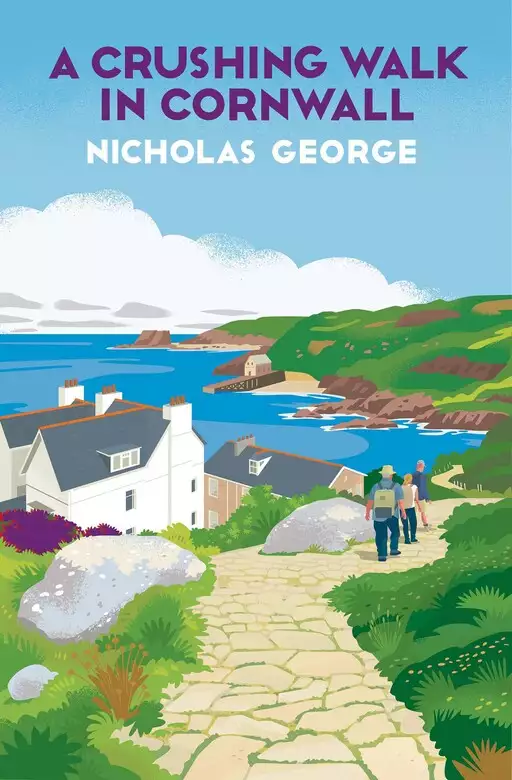
For retired San Diego detective Rick “Chase” Chasen, week-long walks in the English countryside are an enjoyable new pastime. But sometimes these outings take deadly detours…
Chase is disappointed that his partner Mike won’t be joining him on his tour of the rocky Cornish coast—but like long-distance walks, long-distance relationships can require an occasional break. He still has his friend Billie for company, though, and a few more fellow Americans, from a New Orleans restaurateur to a New York travel writer, joining them on their jaunt.
When the group hears before their departure that local landowners have been sabotaging the trail with booby-traps, their walk leader dismisses it as rumor—but some in the group are worried, especially after a terrifying incident on a bridge the very next morning. As they bravely continue their expedition, twelve-year-old chatterbox Ivy, who’s already spilled some of her mother’s secrets, continues gossiping to Chase about the group members. She’s been researching online and thinks they’re not all as they seem. When one of them nearly plunges to her death during a visit to a 16th-century castle, Ivy’s sure a killer walks among them.
That turns out to be a real possibility when the near miss is followed by a suspicious death during a meal break. Did a Cornish property owner take a prank too far? And is Ivy just a drama-obsessed internet addict, or is ignoring her warnings a fatal misstep? If murder is truly afoot, Chase will have to rely on his investigative wits to trip the killer up.
Release date:
March 31, 2026
Publisher:
Kensington Books
Print pages:
288
* BingeBooks earns revenue from qualifying purchases as an Amazon Associate as well as from other retail partners.
At first, I only heard the shrill wails of lapwings. Above me, the birds were swooping in circles, their black-and-white, angular bodies contrasting sharply against the deep azure sky.
Jorge Campos’s screams rang out, rising above the cries of the birds.
“Someone help me! Now!”
My attention snapped to Jorge, panic-stricken, clinging to the railing of the wooden bridge I had just crossed. It had broken with a horrifyingly splintering groan and now teetered dangerously over a deep ravine. Jorge was gripping the railing with one hand, his other hand swinging helplessly over the chasm below, as was his left leg. His right foot struggled to maintain its hold on what remained of the bridge.
I was just about to take action when our walk leader, Brian, dashed past those of us who had already traversed the bridge. The other side appeared to be intact and secure, still connected to both sides of the ravine, but the side to which Jorge was clinging had largely given way. Grabbing the large limb of an oak jutting out from the side of the ravine to secure himself, Brian planted his feet along the railing of the side of the bridge still anchored to the ravine and edged forward, proceeding slowly so as not to cause any jolts that might loosen that side of the bridge. As he neared Jorge, he leaned toward him as far as possible, his free arm outstretched.
“Careful, now,” he said to Jorge. “Swing yourself around, and I’ll pull you in.”
Wide-eyed with fright, Jorge began to angle his body toward Brian, stretching out his free arm as far as he could. We all watched breathlessly as their hands connected. Then we gasped as the bridge let forth another groan and lurched downward before stopping again. Quickly, Brian pulled Jorge toward him. As soon as both of Jorge’s feet were on the bridge’s planks, Brian led him to the rest of us. When they arrived safely on solid ground, we gave Brian a round of applause and cheers.
After our cheers died down, a woman’s voice shouted out from the bridge’s far side. “Hello-o? Does anybody care about me?”
Jorge had escaped a fatal fall, but three of our party were still on the other side of the ravine, and one of them—Jorge’s wife, Luella—was on the bridge itself. Although Luella had just started across and that side of the bridge appeared secure, she was frozen in fright, clutching onto the railing for dear life.
“You didn’t have a problem rescuing Jorge!” Luella yelled to Brian. “So why won’t anyone come and rescue me?” She looked back at the two walkers still on the other side, Rachel Scattergood and her young daughter, Ivy.
“I—I don’t think I can do it,” Rachel said.
“Jorge?” Luella called across to her husband. “Come and get your Lulu!”
“No!” Brian shouted. “It’s too dangerous. Luella, you should be safe if you work your way back to where you came from. Just keep holding on to the railing. It’s not very far.”
“Let me get her!” Ivy said. “I’m not afraid.” She stepped toward the bridge, but her mother pulled her back.
“Are you nuts? You’re staying right here with me.”
From our side, Luella’s son, Ben, yelled out, “For God’s sake, Mother, go back! Just do it, like Brian told you, and you’ll be all right.”
With no other option, Luella began inching her way back, eyes closed. We held our breath, hoping the bridge wouldn’t break free of its tenuous hold and tumble wholesale down the ravine. But soon Luella joined the others. The three stood in a huddle, looking across the ravine at those of us lucky to have reached the other side intact.
Ivy couldn’t wait any longer. “Scaredy cats!” she said. She ventured out, but her mother dashed forward to yank her back just before the bridge gave another groan.
“Please stay off the bridge!” Brian called out. “It’s too hazardous. There’s a way to cross the ravine farther up the hill. Wait a second. I’m consulting the map.” He pulled his cell phone from his coat pocket.
Beside me, Ben said, “I should never have let Mother talk us into coming over here to England.”
“Don’t be stupid,” Jorge said. “This was a minor setback. Happens all the time.”
“Well, it doesn’t happen to me,” said Dave Langdon, the travel writer planning on writing a magazine article about this walk. “If I wanted to live life on the edge, I would have gone hiking in the Himalayas, not walking along the coast of Cornwall!”
I turned my attention to the break in the bridge. Although it was several feet away from where I was standing, I saw a few ragged spears of wood that indicated it might simply have given way under the weight of our group. But a much cleaner break, just beyond that, suggested to me that the bridge may have been booby-trapped.
Brian perused his online map and looked up the hill. “Up a few hundred yards there’s a spot where the others should be able to safely cross the stream without the aid of a bridge.”
“What do you mean, ‘should be’?” asked Roy Hemper, the seventh member of our group. “Don’t you know? What kind of guide are you?”
Brian closed his eyes, took a breath, and opened them. “I’m the only guide you have, Mr. Hemper. I’m telling you what I believe will be the best way forward. I’ve never had to deal with this bridge having a problem before.”
Roy looked chastened. “I’m sorry. I wasn’t expecting this kind of thing on the first day.”
Brian called out to Luella and the Scattergoods, “Make your way up the hillside! Look for a narrow trail. I’ll go up and help you across.” He told the rest of us to stay where we were.
Luella and the Scattergoods began making their way up the hillside.
As we waited, my walking partner, Billie Mondreau, nudged me aside and, out of earshot of the others, asked, “What do you think, Chase? Should we be concerned?”
An accident occurring this early in the walk was not a good sign.
The birds above continued their wailing. Dave looked up at them. “You know what they call a group of lapwings?” he asked. “A deceit.”
Billie and I exchanged looks. I wondered if she was remembering, as I was, something our guide, Brian, had mentioned the previous night at dinner. “I want you to enjoy our walk,” he’d said, “but please be careful. Unfortunate things can happen.”
Unfortunate things can happen.
Brian was most likely speaking about sprained ankles or insect bites, but Billie and I traded anxious glances across the dinner table after he made this comment. We’d both participated on walks on which far worse things had happened. Surely nothing like that could happen again, could it?
Sunday, early afternoon,
St. Mawes, Cornwall, England
When I’d reached Cornwall the day before, my heart beat fast with excitement. There I was, back in my favorite place on the planet—the glorious isle of England—about to embark on another walk, this time along a coastline I’d never explored.
Unlike on past visits, I was being driven to meet the group by my British boyfriend, with whom I’d just spent two days at his home in Devon.
Thinking of Mike as my “boyfriend” sounds juvenile. I’m a man in my late sixties, and so is he. We’d been “dating”—another awkwardly inadequate word—for two years, at first through FaceTime and phone calls (I live in Temecula, California, north of San Diego, while Mike lives in Exeter, Devon), and recently more closely. Mike had just spent three months with me in the States, and now it was my turn to reciprocate and spend three months with him in England. I’d been in the country a couple of days, but our time together would officially start in a week, after the walk concluded.
Mike, unfortunately, couldn’t get the time off from work to join me on the walk. That was just an excuse, I realized. He could have arranged it, but truth be told, Mike was not a fan of country walking like me. I was born with the innate desire to move my legs and let them take me wherever they wanted. When I was a child, this annoyed my parents, who constantly had to search for me as if I was lost. But I never got lost. I always knew where I was; I just wanted to walk much farther than they did.
So I looked forward to being with Mike at his home after the walk ended, and I was heartened to know he was close by. He didn’t live far from the starting point for the group’s walk, the town of St. Mawes, at the end the Roseland Peninsula on Cornwall’s southern coast.
I was looking forward to my stay with Mike, but not without some reservations. His stay with me in California had had its bumpy moments. He didn’t like being so far from home, and in a very different climate. Like me, he had developed routines and habits through the years—reading certain newspapers and frequenting local restaurants—that couldn’t be as easily accommodated in another country. He also hated American food. I wrote these irritations off as normal, mostly certain we were going through an adjustment period.
We had many good moments too. Some, naturally, involved physical intimacy (there’s simply no substitute), and others involved sharing stories of our past. Mostly, we just enjoyed being together. Now it was my turn to live in Mike’s world, and I was facing the same issues. I’d never spent three months away from my home, with its reassuring sights, sounds, and smells. I began to question whether my decision to spend so much time with Mike was a sound one.
Easing the transition was my decision to take part in another group walk, this one along the southern Cornwall coast. My good friend Billie, always on the lookout for guided walks in Britain, had suggested it. I’d never explored Cornwall, with its gorgeous coastline that has been the locale for many films and television shows. Best of all, Billie would be at my side.
As Mike drove, I studied his face, youthful still, framed by a bush of brown hair. He had a lively sparkle in his eyes. But I saw the sparkle dim. Slowing his well-worn MG, he pulled to the side of the road and brought the car to a stop. He began studying the GPS mounted on the dashboard. “According to this, I’m heading the right way, but it can’t possibly be right, can it? It seems as if we’re heading inland rather than toward the sea.”
I looked at the green hills around us. We were still in England, of course, but other than that, we could have been anywhere. “Trust the directions. This road has taken so many twists and turns that it’s impossible to tell north from south.”
He nodded, but with clear misgivings. “Right, then,” he said and pulled back onto the road. Around the next bend, we spotted the small, tasteful sign announcing The Carne, the hotel where my group was booked for the first three nights. He slowed, and we viewed the white façade of the hotel’s main building, beyond which a small blue bay presented itself, surrounded by rocky bluffs. The subtropical breezes made conditions perfect for huge, solid, and fleshy succulent plants; large, spiky cabbage trees along the bluff looked somewhat incongruous beside the red valerians flowering beside them.
Mike found a parking space near the entrance. When he switched off the engine, he looked at the hotel and gave a whistle. “You won’t be exactly roughing it, will you, Chase?”
I smiled. “You still are more than welcome to join me, you know.”
“Can’t do,” he said. “You know that.”
Further discussion about this would grow contentious, so I said nothing. Mike claimed that because he’d just taken a three-month leave to be with me in the States, he couldn’t afford to take any additional time off from his job. Given his tenure and reputation as county coroner with the Exeter Police Department, I doubted that was true.
We stepped out of the car just as a dapper man in a blue waistcoat walked up from the hotel entrance to get my bag. He noted the luggage tag and said, “You’re with South Coast Walkers, is that right? Three of your lot are in the sitting room.”
He carried my bag off as I remained with Mike.
“Want to come in and have a look around?” I asked.
He gave me a nervous smile. “Thanks, but I should be getting home. Do you mind? First day back on the job tomorrow, you know. Lot of catching up to do.”
We’d been together for the past three months in the States. This would be the first night in months that we’d be apart. A tear welled in my eye.
Mike smiled, stepped forward, and stroked my chin. “Be strong, Chase. I’m only half an hour away.”
I led him to a private spot beside a berry-laden dogwood tree where we could hold one another without being seen. “I’ll miss you,” I said.
“And I’ll miss you. But it’s only for a week. After that, you’ll see so much of me, you’ll grow tired of my face.”
I looked into his eyes. “I don’t believe I could ever do that.”
We shared a longer kiss than usual, and I promised to phone him later that evening. He gave me a smile and walked back to his car. Before getting in, he said, “Remember my advice. No murders this time!” He was referring, of course, to two murders that had occurred on previous group walks, both of which he became involved with in his professional capacity.
He drove off, passing a dark-blue Volkswagen Golf coming up the road and stopping at the spot that Mike had just vacated. I noted an Uber sticker on the vehicle’s window. A slim Black man in his midforties stepped out of the back seat and eyed his surroundings before smiling at me. “Are you with the walking group?” he asked in an accent I pegged as American Southern—perhaps Louisiana.
“I certainly am,” I said, returning his smile and extending my hand. “Rick Chasen.”
“Roy Hemper,” he said with a smile. “Brother, it’s nice to hear an American voice. I’m having trouble understanding a lot of the people over here.”
The Uber driver brought out Roy’s suitcase and backpack. He thanked him before looking at the hotel’s white stone façade, with its graceful arch and front walkway. He formed an appreciative smile.
“I was expecting something grim and castle-like,” he said.
“This part of Cornwall is more like the French Riviera,” I said. Taking a deep breath, I added, “Can’t you smell the salt air? It’s almost like we’re in Monte Carlo.”
Roy nodded and chuckled. “I spent the last two nights in London. I figured it would be better to hire an Uber instead of having to deal with the trains over here.”
“The UK rail system is pretty good,” I said, “but overall, I think you made the right decision.”
Roy picked up his bags, and we walked toward the hotel entrance, a small whitewashed building roofed in shiny blue shingles, when a large van pulled up—the shuttle from the Truro rail station, according to a sign on the windshield. The driver hopped out and slid open the side door. A sandy-haired older woman emerged, dressed stylishly in a yellow linen top and white slacks. Dangly bracelets adorned her arms. She removed her sunglasses to survey the hotel as three others stepped out—a tall, physically imposing dark-haired man with a thick, dark-bristled moustache; a shorter, less imposing clean-shaven man; and a man with dark blond hair who maintained his distance from the others.
The last one off the shuttle was a welcome sight: a familiar older woman with tightly coiled gray hair. Billie grinned when she spotted me. “Chase!” she exclaimed, and rushed forward to give me a hug.
The stylish woman stepped up to Roy. “The bags are in the back of the van. Be very careful with the yellow one, that’s mine. Which way is the hotel reception? We’ll meet you there.” Her voice was a mix of whiskey and tobacco.
It took a moment for Roy to understand what she was getting at. “I’m sorry, ma’am,” he said. “I don’t work here.”
She cocked her head, confused, and the waistcoated young man who had taken my bag appeared. Catching on, she repeated the same instructions to him.
“This is quite a spread, isn’t it?” the tall man said in a husky, deep voice as he eyed the property. “Four-star, I believe.”
The woman was more concerned with the manner in which her suitcases were being handled. She watched the bellman wheel them off before saying, “I suppose. Come on, Jorge. Let’s get inside. I need a drink.”
The two walked off, the shorter, clean-shaven man following. The blond-haired man stayed with me and Roy.
“You haven’t met Mr. and Mrs. Campos yet, have you?” he asked Roy and me with a strong trace of disdain in his voice. “Boy, do you have a treat in store.”
“Are you here for the walk?” Roy asked the man.
“Yep, but I’m not with that bunch,” the man replied. “Dave Langdon. From New York. How do you do?”
“Rick Chasen, California.”
Roy introduced himself. “Looks like we’re all here then. Nine of us, aren’t there?”
“Ten, if you include our guide,” I said.
The bellman returned for the remaining bags. As we followed him into the hotel, I put my arm around Billie. “Great to see you, my old friend. How have you been?”
“The usual. Fighting my advance into the golden years tooth and nail. My left knee has some arthritis. What about you? How is the torrid love affair going?”
I laughed. “The ‘torrid’ part wore off pretty quick, but the rest of it is going just fine.”
“Will I be hearing wedding bells soon?”
My face clouded. Mike and I hadn’t discussed formal recognition of our relationship, although I sensed it had been weighing heavily on his mind. Same-sex marriage was now common in both his country and mine. He knew I hadn’t married my previous partner, Doug, who had passed away a couple years before, even though same-sex marriage had been legal in the States for some time. That was Doug’s hang-up; he regarded marriage as a heterosexual institution, even though his devotion to me, I knew, could not have been more solid.
“We’re taking things one step at a time,” was all I said to Billie. My focus went to her sweater, one of her own creations. I looked closer at the images repeated in the pattern. Were those … parrots?
Before I could comment, we reached the front desk, where our bags had been placed to the side. A trim young woman, hands clasped before her, greeted us with a smile. “Welcome to The Carne,” she said in a crisp Cornish accent. “I’m Lily. Your rooms will be available shortly. In the meantime, I believe your group is convening in our sitting room. It’s right through there.” She motioned toward a small room on the other side of an alcove.
The others’ eyes turned toward us when we walked in. Besides those who had arrived via the rail shuttle, there were three others—an attractive, brown-haired woman I assessed to be in her late thirties; a teenage girl with long, straight, black hair and big, round, black-rimmed glasses; and a balding man with a broad smile, who turned to the group and said, “Good afternoon and welcome! I’m Brian Teague, your walk leader. I appreciate everyone arriving so promptly. Now that we’re all here, we can toast to the start of a memorable week on the South West Coast Path. Please, help yourself to wine over there on the sideboard.”
Most of the group had already collected their glasses of wine; the rest of us quickly got ours. The young girl came and wedged herself in between Billie and me.
“Ivy, come back here,” the brown-haired woman said. “You know I’m not comfortable with you drinking wine.”
“How can I toast with an empty glass?” the girl replied. “Besides, Father lets me drink wine all the time. Harder stuff too—scotch whiskey and vodka shooters.”
The woman—her mother?—frowned. “All these people are going to think you’re … oh, never mind. I’m in no mood to argue right now.”
The girl smiled devilishly up at Billie and me. She whispered, “She’s not really my mother. I’m actually a long-lost member of the royal family. We’ve come to England to reclaim my place in the line of succession. But it’s a secret.”
I traded looks with Billie as Ivy helped herself to the wine. Once we had ours, Brian walked into the center of the room.
“Everyone have their wine? Very good. Again, welcome! I’ve lived my whole life in this part of England and know Cornwall very well, so trust me that you’ll be in good hands. I’ll review what’s in store for us in the next few days over dinner, but at the moment, please join me in a toast to a wonderful week!”
We raised our glasses and said, “Cheers!” before sampling our wine. To my amazement, Ivy downed her entire glass in one go.
“Perhaps we can introduce ourselves?” Brian prompted. He nodded to the brown-haired woman beside him.
It took her a moment to get the hint. “Okay then. I’m Rachel Scattergood, from Chicago, in the US. I’m an attorney.”
“And what prompted you to come here to England, Mrs. Scattergood?” Brian asked.
Rachel g. . .
We hope you are enjoying the book so far. To continue reading...

 Please log in to recommend or discuss...
