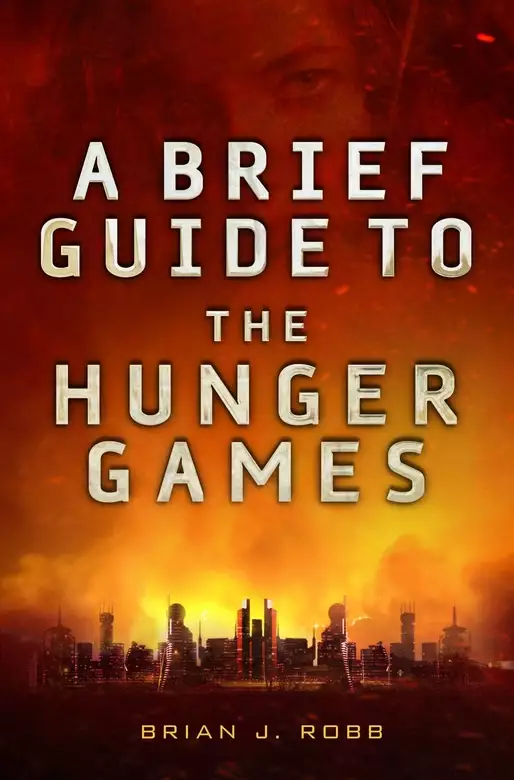
A comprehensive and compelling guide to Suzanne Collins's bestselling young-adult, dystopian trilogy The Hunger Games, Catching Fire and Mockingjay. Already a publishing phenomenon to rival Harry Potter (over 50 million copies sold), the four blockbuster movies starring Jennifer Lawrence have grossed almost $3 billion dollars at the box office. Suzanne Collins has created a series of characters and situations that have struck a chord not only with the target audience of teenagers, but which have also drawn in adult readers: the series is second only to Harry Potter in NPR's popular poll of the Top 100 Teen Novels.
Robb explores themes in The Hunger Games, and the influences and inspirations that lie behind the books, highlighting where Suzanne Collins has drawn on mythology and history, reshaping them to fit her universe. He examines the characters and situations created in the book and how these have impacted on the books' largely teen readership. He also looks at reactions to the books from fans and critics, both acclaim and criticisms faced by the author.
Robb chronicles the adaptation of The Hunger Games from acclaimed, best-selling novel to blockbusting film. With a script by Suzanne Collins herself, the film has made stars of Jennifer Lawrence as Collins' heroine Katniss Everdeen, Josh Hutcherson as Peeta Mellark and Liam Hemsworth as Gale Hawthorne.
Release date:
August 21, 2014
Publisher:
Little, Brown Book Group
Print pages:
288
* BingeBooks earns revenue from qualifying purchases as an Amazon Associate as well as from other retail partners.
The Hunger Games has become a huge, worldwide phenomenon. What started with a big-selling young adult novel has turned into a multimillion-dollar blockbuster movie series, and much more besides for the legions of fans of Katniss Everdeen, Peeta Mellark, Gale Hawthorne and Finnick Odair.
The trilogy of young adult books comprising The Hunger Games, Catching Fire and Mockingjay (known collectively as The Hunger Games trilogy or saga) by Suzanne Collins follows the ordeals of tough, self-reliant teenager Katniss Everdeen. She becomes a Tribute in the annual Hunger Games, a battle to the death fought by young people from all over Panem (the future United States). More than that, through her actions Katniss also becomes the figurehead of a rebellion against the dreaded Capitol and those who rule Panem in their own interests and not those of the people.
The sales surge of the first book, published in 2008, took publishers Scholastic by surprise. They’d put 50,000 copies of the hardback out, a large number for a new series, but Suzanne Collins was a well-known and successful author thanks to The Underland Chronicles, and the advance buzz on the book from editors, stockists and the media had been overwhelmingly positive. Despite this, they’d underestimated the interest, and the book had to go back to print twice, bringing the number of hardback copies up to 200,000. Within two years, The Hunger Games had sold to thirty-eight countries in twenty-six different languages and had sold over 800,000 copies in the US and Canada – the first printing of the final book, Mockingjay, would reach those numbers immediately.
For over 100 consecutive weeks, The Hunger Games featured on the New York Times bestseller list. It was followed by Catching Fire in September 2009, with an initial print run of 350,000 copies, soon boosted to 750,000 by 2010. The final volume, Mockingjay, came out in the summer of 2010, selling 450,000 copies during its first week on release, with a total planned print run of 750,000 increased to an eventual 1.6 million to meet overwhelming demand. Overall, worldwide the three books have twenty-six million copies in print (including the inevitable movie tie-in editions). Suzanne Collins became the first children’s or young adult author to sell over one million books for the Kindle ebook reader, only the sixth author of any category to do so. Analysis of the geographical sales of the books in the United States indicated that they were most popular in California, Utah and Florida.
The books have been festooned with awards. Publishers Weekly named The Hunger Games as one of its Best Books of the Year for 2008, while the New York Times acclaimed it as a Notable Children’s Book of 2008. Booklist editors and School Library Journal agreed, similarly praising The Hunger Games. As the book spread, so did the fame of its reclusive author. By 2011, Suzanne Collins had been awarded the California Young Reader Medal for The Hunger Games, and by 2012 the Scholastic Parent & Child magazine listed the book as the thirty-third best book for children of all time, with a special notice for ‘best original ending’.
The books struck a chord with teenagers going through high school: the trials and tribulations Katniss faced in the Games arenas were symbolic of those most young people face when growing up. In overcoming their own limitations, facing up to bullies, struggling to escape the influence of their parents, every teen reader of The Hunger Games trilogy could see how this exotic dystopian fantasy could nonetheless reflect elements of their own lives. That core identification between the young readers and Katniss, Peeta and Gale is what drove Suzanne Collins’s work to be so successful. It also appealed to older, adult readers for many of the same reasons: high school is sometimes seen as the best years of people’s lives, but for many others they were the worst years.
The four movie versions of the trio of novels brought The Hunger Games saga to a whole new audience. As well as the readers of the novels, the movies – created and promoted as seasonal blockbusters released across a four-year period – were deliberately aimed at everyone. The writers and producers took the books and brought the characters to life in the form of stars Jennifer Lawrence, Josh Hutcherson and Liam Hemsworth, among a host of others. The epic nature of the story and the humanity of the lead characters appealed to the widest possible audience, so much so that the second movie, Catching Fire, became the biggest film at the US box office of 2013.
This is the story of The Hunger Games: how it began when author Suzanne Collins was flicking through television channels one night, between war footage and reality television gameshows; how she turned that spark of inspiration into a bestselling trilogy of young adult books packed with thoughtful messages; and how the ‘girl on fire’ came to the screen in a quartet of movie blockbusters led by Jennifer Lawrence as Katniss Everdeen.
Let the Games begin!
Note: As there is detailed discussion of all three novels in The Hunger Games saga and the movies made from them, this volume contains many plot-point spoilers so is best read after reading the books and seeing the movies.
If there is one Gamemaker more important than Seneca Crane or even Plutarch Heavensbee, then it’s the author of The Hunger Games, Suzanne Collins. Without her original conception of the Games, inspired when she was flicking between television channels covering the Iraq War and a reality show, there would be no Panem, no Katniss Everdeen and certainly no Hunger Games phenomenon.
Suzanne Marie Collins was born into an American military family, which meant that from a very early age she had become used to frequently moving around the country. Her life began in Hartford, Connecticut on 10 August 1962 as the youngest of four children, but she was destined to have a disrupted childhood that would feed into her later literary creations.
Her parents, Jane and Michael, already had three children – Kathy, Joanie and Drew. Some of Suzanne’s earliest memories are of men in uniform drilling at West Point, where her pilot father (who rose to the rank of Lieutenant Colonel) was teaching military history on loan from the Air Force. ‘My father was career military,’ Suzanne said. ‘He was a veteran [and] a doctor of political science. He taught at West Point and Air Command Staff and lectured at the War College.’ Experience of war ran deep in her family. Her grandfather had been gassed in the Great War, and her uncle suffered shrapnel wounds during the Second World War, so the dangers of military life were ever evident. In 1968, when Suzanne was aged six, the Collins family moved to Indiana.
Her understanding of the impact of warfare on family life came a lot closer to home when her father left to serve in Vietnam – an event that helped focus her feelings about war and its effects on the young, both those directly involved and those left behind. ‘If your parent is deployed and you are that young,’ she remembered, ‘you spend the whole time wondering where they are and waiting for them to come home. As time passes and the absence is longer and longer, you become more and more concerned – but you don’t really have the words to express your concern. There’s only this continued absence.’ This would be translated to absent fathers in her fiction, notably Gregor’s missing father in The Underland Chronicles and Katniss’s loss of her father in The Hunger Games. The eventual war depicted in Mockingjay between the Districts and the Capitol owes something to Suzanne’s understanding of the war in Vietnam.
She noticed that her father returned from Vietnam changed. ‘I think he felt it was his responsibility to make sure that all his children had an understanding about war, about its cost, its consequences,’ she said. He suffered ‘nightmares . . . that lasted his whole life,’ according to Suzanne. She often awoke in the night to hear him crying out as a result of painful dreams. Suzanne would give similar disturbing dreams to Katniss Everdeen, who suffers Post-Traumatic Stress Disorder following her experiences of the 74th Hunger Games.
Five years after her father’s return from the conflict, the family were on the move once again, this time to Europe. The Collins clan moved to Brussels, where young Suzanne studied European history, especially the Second World War, a conflict that had a much more marked effect on the landscape and peoples of Europe than on the US. ‘Europe,’ she said, was ‘one gigantic battlefield.’ The family would occasionally take tours of historic battlefields, some of them dating back to ancient times.
A family trip to a castle, expected to be ‘fairy-tale magical’ by young Suzanne, instead turned into a lesson on fortresses. ‘My dad’s holding me back from the tour to show me where they poured the boiling oil,’ Suzanne remembered, ‘where the arrow slits are. And then you’re just like, wait a minute! This isn’t what I had in mind. I should have known better . . . I felt like I was tutored [by] somebody very experienced in [war], both as a real life and historical.’
These trips were not just to honour the war dead or to provide a distraction for a young family on the weekend. Suzanne’s father was a historian, so as well as showing Europe to his daughter and her siblings, he was also filling their heads with detailed histories of each place visited. ‘He talked about war with us from very early on,’ said Suzanne of her father. ‘It was very important to him that we understood things, I think because of both what he did and what he had experienced. If you went to a battlefield with him you didn’t just stand there. You would hear what led up to this war and to this particular battle, what transpired there, and what the fallout was. It wasn’t like, there’s a field. It would be, here’s a story.’
The notion of stories and their connections to real places became fixed in Suzanne’s mind. She read a lot as a child, but often children’s stories were quite separate from the realities of the world in which she lived. She also came to realize that the places in which people lived, especially places that had seen war, were shaped by past events that had taken place there. Those events, and the reasons that things were the way they were in the world, made up the stories of the people who lived there. ‘If I took the forty years of my dad talking to me about war and battles and taking me to battlefields and distilled it down into one question,’ she said, ‘it would probably be the idea of the necessary or unnecessary war. That’s very much at the heart of it.’
Stories she’d read also informed Suzanne’s experiences of the wider world. For example, a sighting of a field of poppies recalled not the Great War battlefields known as Flanders Fields – the connection her father might make – but the poppies in one of her favourite books and films, The Wizard of Oz. ‘This moment becomes transformative,’ she recalled of her father connecting the poppy field to the war, ‘because now I’m looking out on to that field and wondering if it was a graveyard.’
Upon returning to the US, Suzanne attended George Washington Carver High School in Alabama, where she furthered her interest in reading and mythology, having grown more interested in them during her European stay. Suzanne developed a taste for macabre stories in Junior High. ‘In fifth and sixth grade [between ten and twelve years old], I went to school in an open classroom. And the English teacher, Miss Vance, was wonderful. On rainy days, she would take whoever was interested over to the side and read us Edgar Allan Poe stories. I remember all of us sitting around just wide-eyed as she read “The Telltale Heart” or “The Masque of the Red Death”. She didn’t think we were too young to hear it. And we were riveted. That made a huge impression on me.’
Suzanne had a variety of favourite books as a child, but even she found school reading assignments sometimes difficult. The Mayor of Casterbridge (1868) by Thomas Hardy was one she found a tough read, so tough in fact that she never finished it. ‘It was assigned in tenth grade,’ she said, ‘and I just couldn’t get into it. About seven years later I rediscovered Hardy, and consumed four of his novels in a row. Katniss Everdeen owes her last name to Bathsheba Everdene, the lead character in Far From the Madding Crowd (1874). The two are very different, but both struggle with knowing their hearts.’
Books dealing with traditional mythology were a large part of Suzanne’s reading growing up. ‘I’ve had a lifelong love of mythology, so I’d have to top the list [of favourites] with Myths and Enchantment Tales, by Margaret Evans Price, which belonged to my mom when she was a girl, and D’Aulaires’ Book of Greek Myths. Fiction standouts include A Wrinkle in Time, by Madeleine L’Engle; The Phantom Tollbooth, by Norton Juster and Jules Feiffer; and Boris, by the Dutch writer Jaap ter Haar, which I still think is one of the best war stories written for kids.’
Suzanne soon developed a list of favourites she’d return to and reread over the years, including family saga A Tree Grows in Brooklyn by Betty Smith; George Orwell’s dystopian Nineteen Eighty-Four, no doubt an influence on the totalitarian regime in The Hunger Games; William Golding’s The Lord of the Flies, which in its tale of children turning on one another is clearly also an influence on The Hunger Games; The Heart is a Lonely Hunter by Carson McCullers, about a deaf man’s experiences in thirties America; and Ray Bradbury’s Dandelion Wine, inspired by that author’s own late-twenties childhood. The book that scared her the most was the real-life account of a virus outbreak, The Hot Zone by Richard Preston. The one that got away – the book Suzanne knew she ought to have already read, but has never gotten around to – was Dostoyevsky’s The Idiot, although she’d come close in reading several theatre adaptations when working for the Classic Stage Company.
Suzanne followed junior school with time at Alabama’s School of Fine Arts where she was a Theatre Arts major, graduating in 1980. She later attended Indiana University, leaving there with a double major in Drama and Communications in 1985. Although acting had interested Suzanne in her early teens, she had moved beyond that. Her combined focus on theatre and drama, alongside communications, clearly marked Suzanne out as likely to pursue a career in either theatre or television – not as an actor, but as a writer. During her time at Indiana University she met a young aspiring actor named Charles Pryor, who was widely known as ‘Cap’ and who would become her husband in 1992.
‘When I got out of undergrad,’ she remembered, ‘I had a degree in theatre and telecommunications. [In] my first job, I was a news reporter for the local stories for NPR [National Public Radio]. Then I was a country-western DJ. I did data entry for a yearbook company. In my mid-twenties, I went back to grad school at NYU [New York University], and I specialized in playwriting.’ In 1987, at the age of twenty-five, Suzanne and Cap moved to New York, where she took up a Master of Fine Arts in dramatic writing at New York University. Her big career break was just around the corner. ‘I worked in development for a film producer for a year and a half or so, and then I got my first television writing job.’
Suzanne quickly broke into working on children’s television in the city. ‘The first show I did was in 1991. It was a live-action show called Hi Honey, I’m Home!’ she remembered. She worked on a variety of shows for younger viewers that aired on Nickelodeon, including Clarissa Explains It All (1991–4), The Mystery Files of Shelby Woo (1996–8, an episode of which – 1996’s ‘The Missing Dolphin’ – featured Suzanne’s husband, Cap Pryor), and Little Bear, an Emmy-nominated series for which Suzanne wrote many episodes. She was the co-creator and story editor for the 2000 animated series Generation O! Suzanne was nominated for the Writers Guild of America Award for Animation for the 2001 Rankin/Bass seasonal special for Fox, Santa, Baby (which she co-wrote with Peter Bakalian). Later she became the lead writer for the show Clifford’s Puppy Days, based upon a series of books published by Scholastic (who were later to be Suzanne’s publisher). Even after being published, Suzanne continued to keep her hand in with children’s television, freelancing for the 2008–9 Nick Jr show Wow! Wow! Wubbzy! ‘It’s a fun preschool show that’s set in this imaginary town called Wuzzleburg,’ she said. ‘When I was working on The Hunger Games – there’s not a lot of levity in it – I’d do a Wubbzy script. It was an enormous relief to spend some hours in Wuzzleburg, writing an eleven-minute episode, where I know things are going to work out just fine and all the characters will be alive at the end.’
While working on the Kids’ WB show Generation O! Suzanne met the show’s co-creator, children’s writer and illustrator James Proimos (author of the Johnny Mutton series and Patricia von Pleasantsquirrel). He encouraged her to think about writing her own children’s books. By then she’d had two children of her own, a son Charlie (born 1994) and a daughter Isabelle (born 1999). She set out to put her accumulated knowledge of writing for children via television to work in writing an adventure story aimed at younger readers. The result was Gregor the Overlander, published in 2003 when Suzanne was forty-one, her first book and the start of what would come to be known as The Underland Chronicles. The series eventually ran to five books published between 2003 and 2007. During 2003 – the year her father died – Collins and Pryor moved with their family from their cramped apartment in Manhattan to a larger family home in Newtown, Sandy Hook, Connecticut (later infamous as the location of an elementary-school shooting in 2012).
In her work on The Underland Chronicles, Suzanne drew influence from another children’s story she loved: Alice’s Adventures in Wonderland. Set in a fantasy land hidden under New York City, Gregor the Overlander followed eleven-year-old Gregor and his two-year-old sister Boots on their trip to the underworld after they fall through a vent in the basement of their apartment. In this strange ‘Underland’ they meet all manner of weird creatures (many of them giant versions of animals and insects familiar to children), before discovering that Gregor is the ‘warrior’ spoken of in an ancient prophecy and Boots is the ‘princess’ worshipped by the creatures. The children are caught up in an ongoing war between the strange creatures known as ‘gnawers’ and the Underland inhabitants. ‘We had two [military] superpowers,’ she said of her Chronicles, ‘the humans and the bats, but the humans were dependent on the alliance with the bats, because then they became aerial fighters.’
For the first time, Suzanne tackled the meaning and effects of war in fiction aimed at children. ‘I’d like to take topics like war and introduce them at an earlier age,’ she said. ‘If you look at Gregor [the Overlander], it has all kinds of topics, but it’s in a fantasy. It’s played out with a combination of humans and rats and bats. But those topics are there.’ The idea to extend the series to five books came from her work on television: ‘Having written for television, the idea that you spend all this time creating this world, developing these characters, and then you’re only going to use them for one story? [Gregor] required a series format. If I had written Gregor as one book, it would have been over 1,700 pages . . . For a nine- to twelve-year-old audience, that would have been daunting.’
She had no doubt, however, that children were smart enough to perceive the messages in the Underland books. They’d know there was something important underlying the adventure, and they were clever enough not only to see it, but to handle some quite disturbing adult topics due to the way they were presented in the guise of fantasy fiction. ‘Kids will accept any number of things,’ she said. ‘The Underland Chronicles – which I wrote for kids the same age as I was when Miss Vance read me Edgar Allan Poe – features death, loss and violence. The third book has biological warfare, the fourth book has genocide, the fifth book has a very graphic war. I wondered if at some point that was going to become a problem. Not for the kids so much, but for parents or schools. It never seemed to. I think somehow if you went on that journey with me from the beginning, you were prepared by what had come before.’ It would be a model that would serve her well writing for slightly older readers with The Hunger Games series.
While working on The Underland Chronicles, Suzanne also wrote a rhyming picture book called When Charlie McButton Lost Power (2005), illustrated by Mike Lester. During 2005 Suzanne attended a question-and-answer session with young readers of her Gregor the Overlander books at the Reed School in Newtown, a rare personal appearance from an author who continues to avoid publicity despite her rapid rise to fame. Her son attended Reed Intermediate School, while her daughter was at Sandy Hook Elementary School. During this time, Cap Pryor was described in the Newtown Bee local newspaper as a ‘stay-at-home dad’. In reply to student questions, Suzanne compared her previous collaborative work in writing for television with the essentially solitary role of a fiction author, although she was happy to be in a position to write about the things that intrigued her. She advised students who wanted to become writers to ‘write about things you love and feel passionately about’. She told them she generally spent about two months planning and researching her books, followed by a four-month period for the actual writing. She also confirmed that her models for Gregor and Boots had been her own children and their relationship with each other. She then signed each student’s book with the motto ‘Fly you high’. The Underland Chronicles would go on to feature in many local Newtown summer reading programmes over the years. In fact, Suzanne had moved into something of a literary neighbourhood, with Sandy Hook boasting James Thurber as a local author, alongside Pulitzer Prize-winner William Swanberg, poet Louis Untermeyer and Sesame Street writer Ray Sipherd.
One evening towards the end of her time working on the final instalment of The Underland Chronicles, Suzanne was watching television in a rather tired and distracted frame of mind. ‘I was lying in bed, and I was channelsurfing between reality TV programmes and actual war coverage. On one channel, there’s a group of young people competing for . . . I don’t even know; and on the next, there’s a group of young people fighting in an actual war. I was really tired, and the lines between these stories started to blur in a very unsettling way. That’s the moment when Katniss’s story came to me.’
The idea of a ‘reality TV’ style competition with life-or-death stakes was mixed in with Suzanne’s lifelong love of classical mythology and storytelling. ‘It’s very much based on the myth of Theseus and the Minotaur,’ she said of the world of The Hunger Games, ‘which I read when I was eight years old. I was a huge fan of Greek and Roman mythology. As punishment for displeasing Crete, Athens periodically had to send seven youths and seven maidens to Crete, where they were thrown into the labyrinth and devoured by the Minotaur, a monster that’s half-man and half-bull. Even when I was a little kid, the story took my breath away, because it was so cruel, and Crete was so ruthless.’
The ruthless world of Crete became Panem, a future United States in which a popular rebellion has been put down and the ruling Capitol requires the remaining twelve Districts to put forward two Tributes every year – a young boy and a young girl – to compete in the televised Hunger Games. In the arena, there can be only one survivor as the Games are a battle to the death. ‘The message is, mess with us and we’ll do something worse than kill you – we’ll kill your children,’ said Suzanne of her mythological inspiration. ‘And the parents sat by apparently powerless to stop it. The cycle doesn’t end until Theseus volunteers, and he kills the Minotaur. In her own way, Katniss is a futuristic Theseus. I didn’t want to do a labyrinth story, so I decided to write an updated version of the Roman gladiator games. I was also heavily influenced by the historical figure of Spartacus. Katniss follows the same arc from slave to gladiator to rebel to [becoming the] face of a war.’
Suzanne was aware of how television coverage. . .
We hope you are enjoying the book so far. To continue reading...

 Please log in to recommend or discuss...
